Conditions, loops, and pattern matching
3.15.2
Choose a branch, iterate over collections, and stop or skip loop iterations.
On this page
Choose a branch
if checks a condition, elif adds another test, and else handles the remaining case. Python uses indentation to mark the block. For equality use ==; use = when binding a name.
total = 20
if total >= 20:
print("Free delivery")
else:
print("Add delivery fee")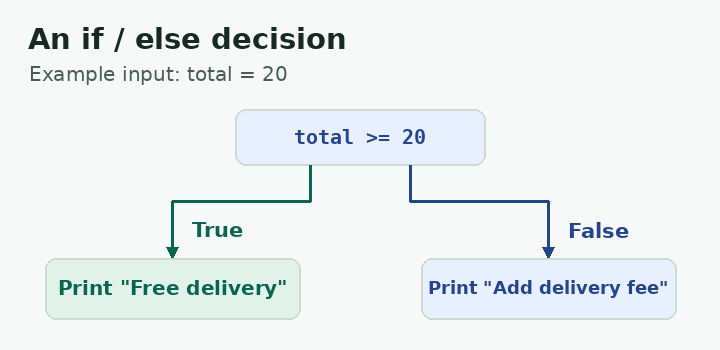 Download image
Example output
Free delivery
Iterate with for and while
for visits an iterable’s items. range(start, stop) excludes stop. while repeats while its condition is true. break exits the innermost loop, continue skips to the next iteration, and pass is an empty statement.
for number in range(1, 6):
    if number == 2:
        continue
    if number == 5:
        break
    print(number)
Example output
1
3
4
Match a value or shape
match selects the first case whose pattern matches and whose guard, if any, is true. A bare name in a pattern usually captures the value. Use quoted literals for exact text and _ as the wildcard.
command = ["show", "Coffee"]
match command:
    case ["show", item]:
        print(item)
    case _:
        print("Unknown command")
Example output
Coffee