Broadcasting, vectorization, and reductions
2.5.5
Apply element-wise operations and summarize over a chosen axis.
On this page
Element-wise calculations
Array arithmetic applies operations element by element. The * operator multiplies matching elements. Use @ or matmul for matrix multiplication.
import numpy as np

quantity = np.array([2, 4, 3])
price = np.array([1.5, 2, 4])
print((quantity * price).tolist())
Example output
[3.0, 8.0, 12.0]
Align shapes from the right
NumPy compares dimensions starting from the right. Two dimensions are compatible when equal or when one is 1. Missing leading dimensions are treated as 1. Use a new axis when aligning a column vector with a matrix.
import numpy as np
marks = np.array([[50, 60], [65, 70]])
print((marks + [5, 3]).tolist())
print(marks.sum(axis=0).tolist())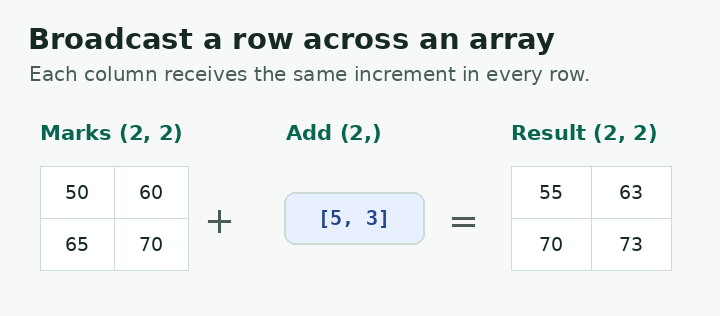 Download image
Example output
[[55, 63], [70, 73]]
[115, 130]
Reduce one axis
In a rows-by-columns array, sum(axis=0) combines rows and returns one value per column. sum(axis=1) combines columns and returns one value per row. keepdims=True retains the reduced axis with length 1.
import numpy as np
marks = np.array([[50, 60], [65, 70]])
print(marks.sum(axis=0).tolist())
print(marks.sum(axis=1).tolist())
print(marks.sum(axis=0, keepdims=True).shape)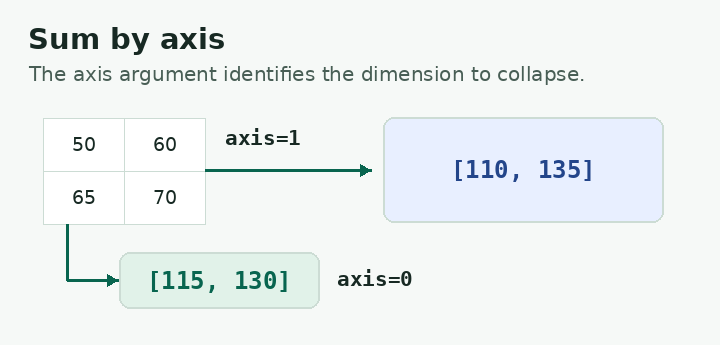 Download image
Example output
[115, 130]
[110, 135]
(1, 2)