Split data and compare with a baseline
scikit-learn 1.9.1
Hold out rows for evaluation, and use a simple prediction rule as a reference.
On this page
Choose a split that matches the task
For independent rows, train_test_split can shuffle and hold out part of the data. random_state makes that split repeatable. Consider stratify=y for classification when enough examples of each class exist. Use time-aware or group-aware splitting when rows are dependent.
from sklearn.model_selection import train_test_split
train, test = train_test_split(list(range(20)), test_size=0.25, random_state=42)
print(len(train), len(test))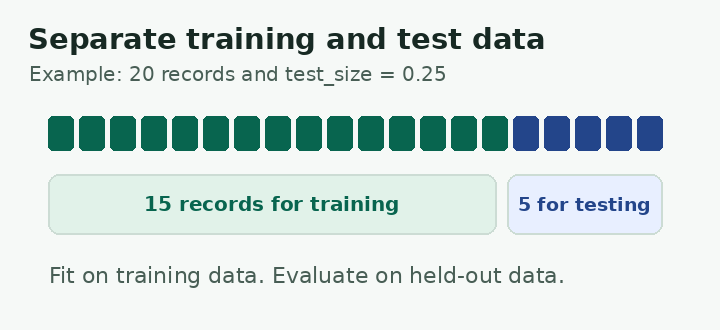 Download image
Example output
15 5
Build a simple comparison
A median-price baseline learns the median of the training targets and predicts it for every test row. Compare models using the same untouched test rows and the same metric.
from sklearn.dummy import DummyRegressor

baseline = DummyRegressor(strategy="median")
baseline.fit([[1], [2], [3]], [5, 6, 20])
print(baseline.predict([[8], [9]]).tolist())
Example output
[6.0, 6.0]