How to Choose a Database for Your Application
Selecting a database requires aligning data structure, access patterns, consistency guarantees, and scaling demands against the architectural trade-offs of each storage engine.
On this page
1. Core Evaluation Dimensions
Evaluate five technical dimensions before selecting a database engine.
- Data model and schema stability. Related records with well-defined fields fit tables. Frequent multi-hop relationship queries can favor a graph, and nested records with varying fields can fit documents.
- Access and query patterns. List what the app reads and writes. Ad hoc filters, joins, and aggregations benefit from a flexible query planner. Predictable single-key lookups can use a simpler access path.
- Consistency and transaction guarantees. Decide whether reads can briefly return stale data and which writes must succeed or fail together. Check transaction scope and read guarantees for the specific engine and configuration.
- Scale and throughput. Separate a larger server from distributing work across servers. Read replicas and caching can offload reads. For write-heavy workloads, evaluate partitioning or sharding, including how writes spread across partitions.
- Operations and ecosystem. Compare deployment, backup and restore, licensing, query language familiarity, and managed-service options. Operational cost can outweigh a small throughput advantage.
2. Database Paradigm Comparison
These are common patterns. Consistency guarantees and scaling options vary by engine and configuration.
| Paradigm | Data Structure | Query Strength | Consistency | Scaling Model | Primary Fit |
|---|---|---|---|---|---|
| Relational (SQL) | Tables with typed columns and constraints | Joins, ad hoc filters, aggregations | ACID transactions. Isolation and replica reads depend on configuration. | Larger primary, read replicas, or distributed SQL depending on the engine | Structured records with relational integrity |
| Document | Nested JSON or BSON-like documents | Indexed field queries and nested document retrieval | Many engines support atomic document writes. Multi-document guarantees vary. | Some engines shard documents horizontally | Semi-structured records with evolving fields |
| Key-Value | Unique keys mapped to values | Direct lookup by key | May be strong, eventual, or tunable | Cluster or partition data when supported | Caching, sessions, and other key-based access |
| Wide-Column | Partitioned rows. Some engines organize columns into column families. | Lookups by partition key and ordered scans within a partition | Often tunable | Distributes writes across nodes when partition keys spread the load | High-ingest logs and time-ordered records |
| Graph | Nodes, relationships, and properties | Multi-hop traversal and path queries | Transaction and read guarantees vary by engine | Scale-up, replication, or partitioning depending on the engine | Queries over densely connected data |
| Specialized (Time-Series / Vector) | Timestamped measurements or embeddings | Time-window rollups or nearest-neighbor search | Depends on storage and indexing guarantees | Time-based partitions or distributed indexes, depending on the engine | Telemetry and semantic similarity |
3. Project-to-Database Mapping
| Project Type | Database Paradigm | Common Engines | Primary Rationale |
|---|---|---|---|
| Banking, Fintech, ERP & E-commerce | Relational (SQL) | PostgreSQL, MySQL, Oracle, SQL Server | ACID transactions and relational constraints across accounts, orders, and inventory |
| CMS, Product Catalogs & Mobile Backends | Document (NoSQL) | MongoDB, Firestore, Couchbase | Nested documents can accommodate fields that vary by record |
| Caching, Session Storage & Real-Time Leaderboards | Key-Value | Redis, Valkey, Memcached, DynamoDB | Fast key-based lookup. Choose an engine with suitable persistence or ranking support for the job. |
| Social Networks, Fraud Detection & Recommendations | Graph | Neo4j, Amazon Neptune | Traverse several connected entities to find paths or neighborhoods |
| IoT Sensors, Server Monitoring & Financial Tick Data | Time-Series | TimescaleDB, InfluxDB, Prometheus | Ingest timestamped data and aggregate it over time windows. Prometheus is primarily for monitoring metrics. |
| Chat, Event Logging & Activity Feeds | Wide-Column | Apache Cassandra, ScyllaDB | Distribute writes and retrieve ordered records by a known partition key |
| AI / LLM Apps, RAG & Semantic Search | Vector | Pinecone, Qdrant, Milvus, pgvector | Store embeddings and retrieve nearest matches. pgvector adds this capability to PostgreSQL. |
| Site Search & Log Analytics | Search Engine | Elasticsearch, OpenSearch, Meilisearch | Index text for full-text search and, where supported, fuzzy matching and faceted filtering |
| BI & Data Warehousing | Columnar (OLAP) | ClickHouse, BigQuery, Snowflake | Scan the columns needed for large analytical queries and aggregations |
4. Multi-Database Combinations in Production Systems
A production system can combine several stores when different workloads have different needs.
- E-commerce platform. PostgreSQL for accounts, orders, and payments. MongoDB or PostgreSQL JSONB for flexible product specifications. Redis for carts and sessions. Elasticsearch for product search.
- Social media platform. MySQL or PostgreSQL for core profiles. A graph database for social links and recommendations. Redis for feed caching. Cassandra for high-volume messaging and activity logs.
- AI knowledge application. PostgreSQL for users and app metadata. A vector database or
pgvectorfor semantic retrieval. Redis for caching frequently requested results.
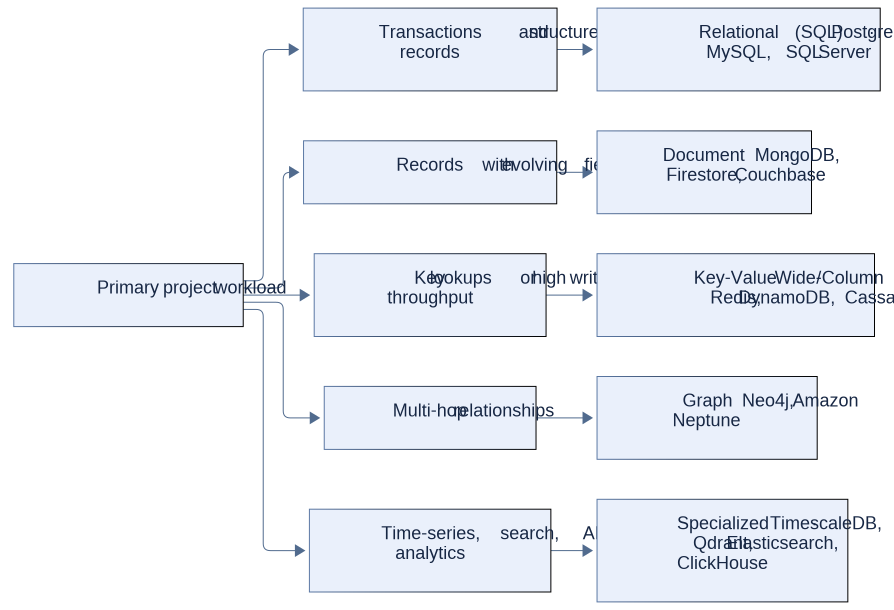
5. Workload Decision Tree
Text Decision Tree
Start with the primary operation the project must handle well.
- Transactional accuracy and structured relations → Relational (SQL). Banking, orders and payments, ERP, or inventory. PostgreSQL, MySQL, and SQL Server support transactions and multi-table joins.
- Flexible, evolving records → Document (NoSQL). CMS, product catalogs, or mobile backends. MongoDB, Firestore, and Couchbase support nested documents with varying fields.
- Fast key lookups or high write throughput → Key-Value or Wide-Column. Redis or DynamoDB for key-based access, such as sessions. Cassandra for partitioned writes and ordered reads, such as event logs.
- Multi-hop relationships → Graph. Social networks, fraud detection, or recommendations. Neo4j and Amazon Neptune are designed to traverse connected records.
- Time-series, search, AI, or analytics → Specialized engine. TimescaleDB for time-window queries, Qdrant or pgvector for similarity search, Elasticsearch for full-text search, and ClickHouse for large aggregations.
Mermaid Flowchart
 Download image
6. Architectural & Starting Principles
- Start with a relational engine when it fits. PostgreSQL supports structured schemas, JSONB, full-text search, and vector search through
pgvector. Consider a specialized engine when an important requirement remains unmet or a measurable bottleneck persists. - Optimize the busiest access paths. Storage engines trade off write amplification, read latency, and storage density. Match indexes to frequent, latency-sensitive operations, and benchmark on representative data.
- Add stores selectively. Multiple stores can address distinct workloads, but they add synchronization work and new failure modes. For an MVP, start with the fewest stores that meet the requirements and add a specialized engine when the benefit is measurable.